SOCOTRA - THE ISLAND AT THE END OF THE WORLD
Socotra! The name resonates like a promise from elsewhere. Lost in the Indian Ocean 350 km off the coast of Yemen, this island classified as a UNESCO World Heritage Site since 2008 is home to one of the most extraordinary floras on the planet.
Durée
16 jours
Les étapes de votre voyage
Points forts
Itinéraire jour par jour

Flight IY525 — Arrival in Hadiboh from Jeddah — Delisha Beach
Flight IY525: departure Jeddah 11:00 AM, arrival Hadiboh 2:00 PM.
Flight IY525: departure Jeddah 11:00 AM, arrival Hadiboh 2:00 PM. From the window, Socotra emerges from the Indian Ocean like a forgotten continent; jagged coastlines, limestone plateaus bleached by the sun, first silhouettes of umbrella-like dragon trees visible from the air.
Socotra has never quite belonged to the world. Detached from the African continent 20 million years ago, it evolved in isolation, developing a flora and fauna found nowhere else on Earth. The Greeks called it Dioskouridès. Arab, Persian and Indian sailors knew it as an essential stop on the spice and incense route — it appears in the Thousand and One Nights, in the tales of Sinbad the Sailor. Marco Polo mentions it in the 13th century. The Portuguese established a fort there in the 16th century. The British made it a protectorate in 1886. It subsequently joined South Yemen, then unified Yemen in 1990.
Since 2015, the war in Yemen has profoundly shaped Socotra's destiny. The island was de facto administered by the United Arab Emirates for several years, which built infrastructure and military bases there. In January 2026, a major geopolitical shift occurred: under Saudi pressure, the Emirates left the island. Flights to Socotra now depart from Jeddah — a tangible sign of a new regional balance of power. The island remains spared from fighting and open to international tourism.
Welcome by our team. Logistics and security briefing. 4x4 transfer to Delisha Beach (15 km east).
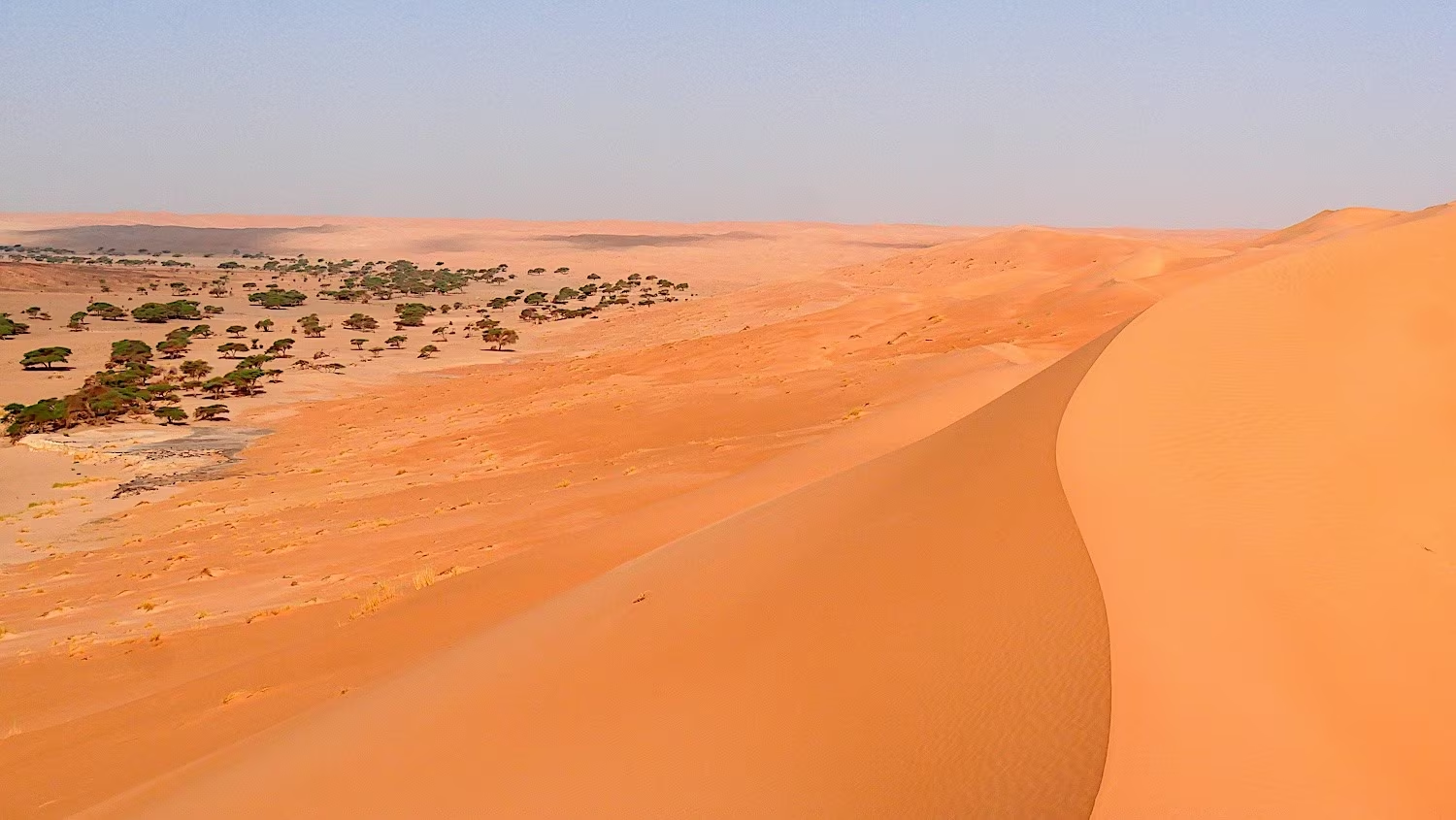
Ascent of the 120-meter dune for the first sunset over the Arabian Sea. Socotri dinner around the fire.
Hadiboh → شاطئ دليشة Delisha Beach

East Coast — Homhil · Hoq Cave · Arher
First full day of discovery. The program is packed, the landscapes radically different from one hour to the next.
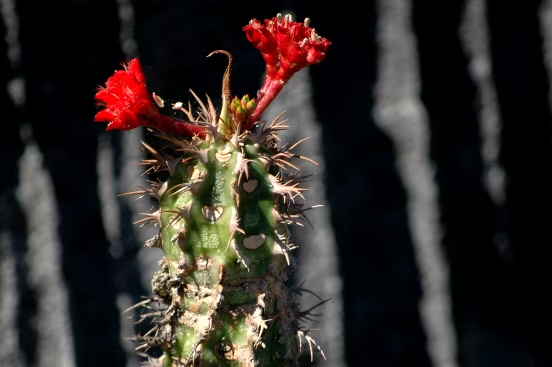
Morning at Homhil Protected Area. The reserve is home to a high concentration of dragon trees, some of which are over 500 years old. Their umbrella-shaped silhouette is an adaptation to monsoon winds. The blood-red resin extracted from their bark — "dragon's blood" — has been used since Antiquity as a dye and healing agent. The Romans used it to tint marble, Italian luthiers of the Renaissance to varnish violins. You also come across the adenium obesum socotranum — the desert rose — and the tree cucumber (Dendrosicyos socotranus), the only tree in the cucurbitaceae family in the world. The Infinity Pool, a natural swimming pool perched overlooking the sea, offers one of the most striking views on the island.
Afternoon: ascent to Hoq Cave (45 min, 500m elevation gain). Socotra's largest cave is home to hundreds of inscriptions carved into its walls in several languages: Greek, South Arabian, Ethiopian, Indian, Palmyrene. They date from the 1st to 6th century AD and testify to the passage of merchants on the incense and spice routes. Socotra was a known stopover between Arabia, India and the Mediterranean.
Late afternoon, Arher Beach. A coastal dune, a freshwater spring, the sea — three elements that coexist over a few dozen meters. Last coastal camp before 7 days in the mountains.
Camp at Arher Beach.
شاطئ دليشة Delisha Beach → شاطئ عرهر Arher Beach

TREK D1 — Adouna → Adho Demelah (1000m)
Last 4x4 to the village of Adouna. This is where the journey changes in nature. The cars stop, the engines turn off, and the silence of the Haggier takes over completely.
The meeting with the cameleer is a special moment. These men know every path, every spring, every mountain passage since childhood, a knowledge passed down from father to son for generations, in a Bedouin culture that has barely changed in centuries. The pack camels, as many as there are members in the group, carry the tents, provisions and cooking equipment for seven days. A real caravan. They advance at their own pace, imperturbable, over terrain that seems impassable.
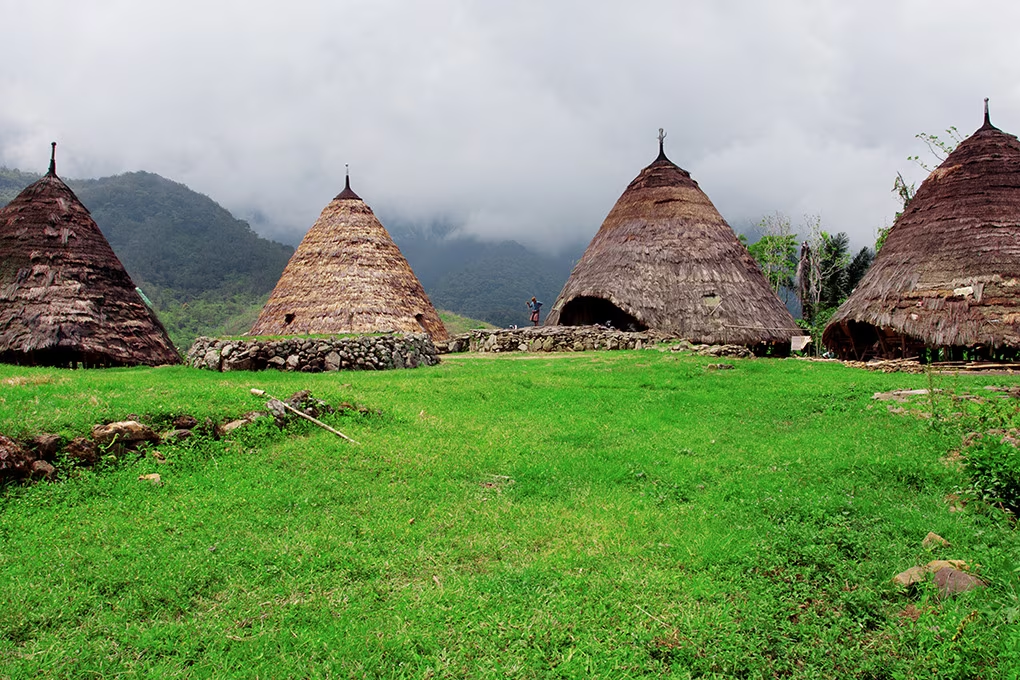
The Bedouins of the Haggier live in almost total isolation. A few families scattered across the heights, stone houses barely visible in the granite, herds of goats grazing on endemic euphorbias. Their economy rests on three pillars: livestock farming, dragon's blood resin sold at the Hadiboh market, and honey.
Socotra honey is one of the rarest and most precious in the world. The island's bees forage exclusively on endemic plants: dragon tree, frankincense tree (Boswellia socotrana), gum acacia, jujube, which grow nowhere else on Earth. The result is an intense black honey with red glints, a smooth texture, a deep taste with resinous and woody notes. Bedouin families pass down their beekeeping knowledge from generation to generation. You will find some at the Hadiboh market at the end of your trip, it is one of the most precious souvenirs you can take back from the island.
The shepherd's path runs along a permanent mountain spring. Granitic terrain, narrow passages, natural pools along the way. First camp at 1000m altitude. The mountain really begins here.
شاطئ عرهر Arher Beach → Adouna (Socotra)
Adouna (Socotra) → Adho Demelah (Socotra)

TREK D2 — Fera → Fareyay
To understand what we see today, we must go back 800 million years. The Haggier are among the oldest rock formations on the planet. Their Precambrian granite formed long before complex life appeared on Earth. These are metamorphic and plutonic rocks shaped by immense tectonic forces, then sculpted for millions of years by erosion, monsoon winds and seasonal rains.
The island rests on two radically different types of terrain. The limestone plateaus formed 65 million years ago at the bottom of tropical seas. The Haggier constitute the original crystalline base, made of granite, gneiss and schist. This duality explains the spectacular diversity of Socotra's landscapes.
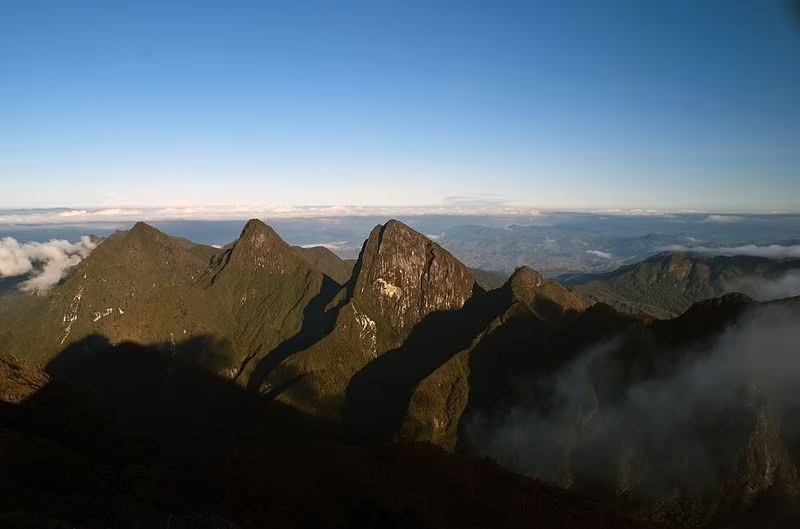
The Fera viewpoint offers this morning the most complete vision of this geology in the open air. This Precambrian granite belongs to the same crystalline base as that which forms the Highlands of Madagascar: Andringitra, Tsaranoro, Marojejy, and Vavavato which some of you know well. Madagascar, Socotra, the Horn of Africa and the Indian subcontinent were once united in Gondwana. Walking in the Haggier is walking on a fragment of the world before — the same world that you have trodden in Madagascar's mountain ranges.
On the limestone cliffs, Begonia socotrana clings to damp crevices. Egyptian vultures soar in the updrafts. The endemic subspecies of Socotra, Neophron percnopterus majorensis, smaller and paler than its continental cousins, has been at home here far longer than man.
Bivouac at Fareyay. Cold night, sky free from light pollution, absolute starry vault.
Adho Demelah (Socotra) → Fareyay (Socotra)

TREK J3 — Bivouac at the summit of Skand (1525m)
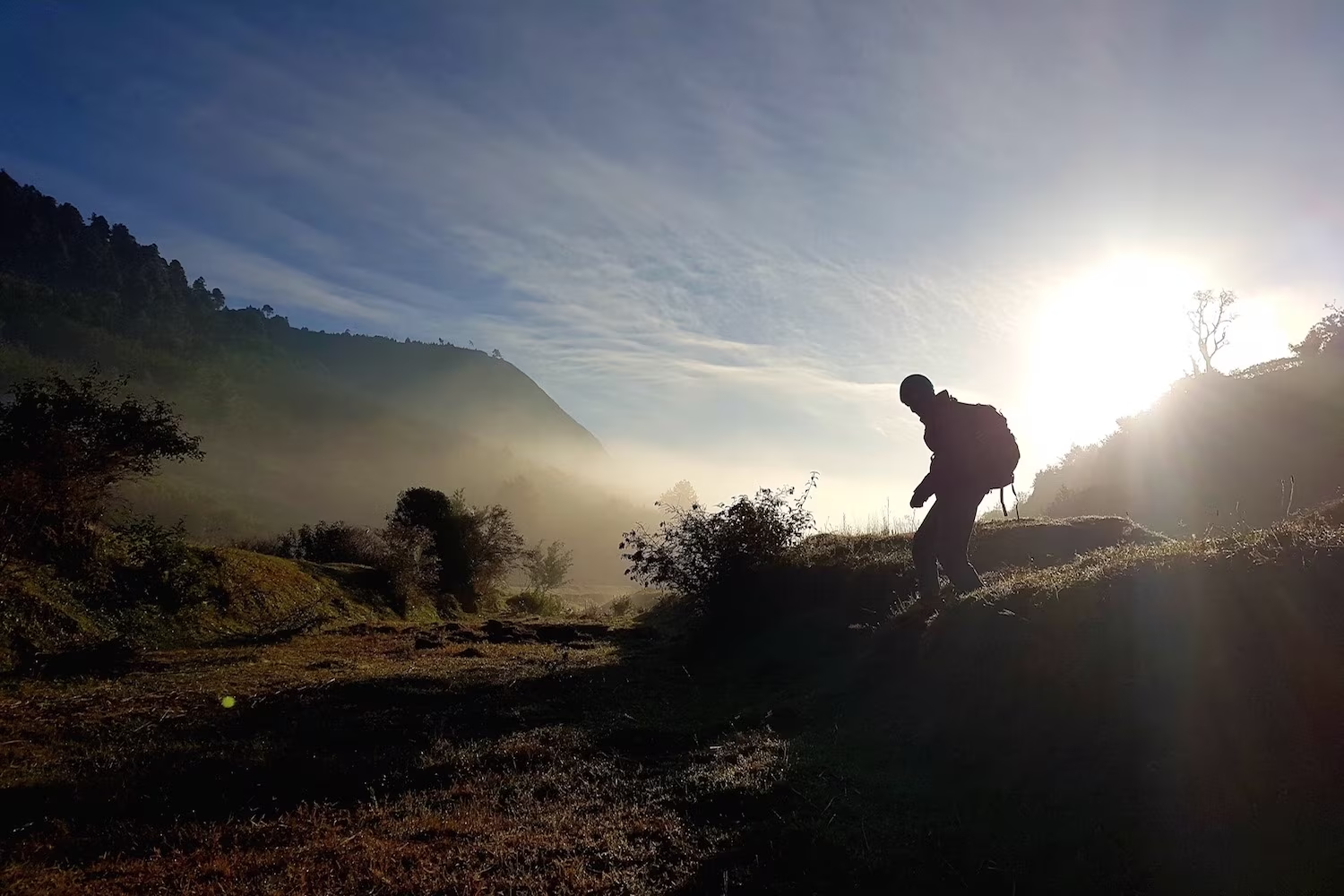
Wake up at 5:00 AM. Departure at 5:30 AM, in the darkness. The guide knows every passage by heart. The group follows in single file, headlamps on, the silence broken only by the sound of the wind and the crunch of soles on granite.
Skånd peaks at 1,525 meters. It is the roof of Socotra. From the summit, the eye embraces the entire island: the Arabian Sea to the north, the Indian Ocean to the south, the limestone plateaus of Dixsam to the east, the deep wadis descending towards the western coast. You understand in a single glance why Arab, Persian and Indian sailors have known this island since Antiquity — it is visible from afar, an unmistakable landmark in the midst of maritime vastness.
The wind is omnipresent. Socotra is one of the windiest islands in the world. The southwest monsoon has literally sculpted life itself: dragon trees have developed their umbrella-shaped silhouette to resist gusts, frankincense trees grow leaning, plants creep along the ground. At the summit of Skånd, this wind becomes a physical presence.
The bivouac at the summit is a deliberate decision. Water has been carried by the guide from the source of Wadi Masaba. The camels wait at Firmihin. Tonight, there is nothing between the group and the sky.
Zero light pollution. The Milky Way visible to the naked eye, dense and close as you barely see it anywhere else in Europe. The ancient Arab sailors who navigated these waters knew each star by its name. It is this same sky that you will observe tonight from the roof of their island.

TREK J4 — Skånd → Daahzaz → Wadi Masaba
The sunrise from 1525 meters is an unparalleled visual experience. Light arrives from the east, from the Indian Ocean, and gradually floods the entire island. The limestone plateaus of Dixsam turn orange, the wadis remain in shadow for a few more minutes, the Arabian Sea to the north takes on a polished metal hue. You stand still, without speaking.
Then the descent begins.
The vegetation changes with every hundred meters of altitude lost. On the heights, bare granite, lichens, a few tufts of hardy grass. Then the first endemic euphorbias — Euphorbia arbuscula with their candelabra forms — which grow in dense colonies on exposed slopes. Their white and toxic latex protects them from goats and camels. They can live for several centuries.
Lower down, the first Boswellia socotrana appear — the frankincense tree of Socotra. Its resin, harvested by incising the bark, is one of the oldest commodities in the world. The trade routes that crossed these waters 2000 years ago carried precisely this resin to Egypt, Rome, Persia and India. The Bedouin families of the Haggier still harvest it today using the same ancestral gestures.
The permanent spring of Wadi Masaba is heard before it is seen. On an island as arid as this one, the springs of the Haggier are a precious anomaly: the mountains intercept monsoon fogs, humid air condenses and feeds underground aquifers that will resurface as springs on the northern flanks. This phenomenon is what allows Bedouin life in the Haggier. It is also this phenomenon that makes our trek possible.
The natural pools of Wadi Masaba are the reward of the day. Clear water, cold, perfect.

TREK J5 — Firmihin Forest
There are places that change something in you. Firmihin is one of them.
The forest is home to the highest density of dragon trees in the world. Hundreds of Dracaena cinnabari, some of which are 600 to 900 years old, rise up on the limestone plateau in a silence that belongs only to them. Their umbrella-shaped silhouettes, their smooth grey trunks, their interlacing branches form a vegetable vault that cannot be found anywhere else on Earth.
The dragon tree is a botanical anomaly. Its growth is slow, almost imperceptible, and it is impossible to give it a precise age. Its bright red resin — dragon's blood — runs through all civilizations: the Romans imported it to treat wounds, the Arabs made it a major trade product, Italian Renaissance luthiers incorporated it into their varnishes. Some believe that the Stradivarius owes part of its sonority to this resin. Today, Bedouins still harvest it according to the same ancestral gestures.
A visit to Fatima's nursery, supported by the Dragon Blood Tree Association, shows the other side of the coin: without human intervention, Firmihin forest is doomed. Overgrazing and climate change threaten these ancient trees. Every young dragon tree replanted here is an act of resistance.
Bivouac in a clearing under the dragon trees. The light filtered by the vegetable umbrellas creates shadows that resemble nothing known.
TREK D6 — Plateau Dixsam → Wadi Dirhur
After the granitic Haggier mountains, the Dixsam plateau is another face of Socotra. Limestone has replaced granite, the landscape has opened up, vegetation has transformed. You walk on the bed of a tropical sea that disappeared 65 million years ago — each limestone slab beneath your feet is an ancient marine sediment, compressed, uplifted, exposed to the Arabian sun.
The dragon trees of Dixsam are different from those of Firmihin. More spaced out, more exposed to wind, their umbrellas even wider still to capture the maximum light on this plateau battered by the elements. As far as the eye can see, their silhouettes punctuate a mineral landscape of absolute austerity.
On the limestone cliffs, Dorstenia gigas clings where nothing else could survive. This bottle tree endemic to Socotra stores water in its trunk swollen like a waterskin — a remarkable adaptation to the extreme aridity of the plateau. Its translucent trunk, almost phosphorescent in the raking light of morning, is one of the strangest botanical curiosities on the island.
Then the canyon opens.
Wadi Dirhur is a fissure in the limestone several hundred meters deep. The same geological logic as the American Grand Canyon: water found a weakness in the rock and carved it out over millions of years. The descent into the canyon is a plunge into another world. The temperature drops, humidity rises, vegetation explodes suddenly. Palms, endemic fig trees, tall grasses border the freshwater pools at the bottom of the wadi. The contrast with the arid plateau is striking — a few hundred meters of elevation separate two radically different ecosystems.
Bivouac at the bottom of the canyon. The silence is total, the night sheltered from the wind by the cliffs.
TREK J7 — Noged Plains → Zahek Dunes
The final stage. The longest one.
We leave Wadi Dirhur canyon to the south. The Noged plains open up before the group like another continent: arid savanna, low vegetation, ochre earth, heat returned. After six days of mountain and canyon, the barrenness of Noged is almost violent. We walk.
Then the dunes appear.
The Zahek dunes are a rare geological phenomenon. The prevailing wind has been pushing coral sand for millennia from the beach towards the foothills of the Haggier, creating perched dunes of white sand that abut against the mountain. Luminous, almost unreal after days of granite and dark limestone.
And behind the dunes, the sea.
The Indian Ocean appears suddenly, between two sand ridges. This precise moment — shifting from the mountain slope towards the coast, seeing the sea after seven days without it — is one of the most powerful of the journey. The 4x4s wait on the coastal track. The camels arrived before us.
Seven days. Sixty-five kilometers. From north to south of the Haggier, on foot, without a vehicle. It's over. It's accomplished. And like at the end of all great treks, you're happy it's finished, and you wish it could start again.
Bivouac on the dunes, facing the Indian Ocean.

Dagub Cave · South Coast · Road to the West
This morning, the body knows it has walked for seven days. The rhythm changes. The cars resume, the engine turns, we settle into the seats with quiet satisfaction. The trek is behind us. The island continues.
Dagub Cave opens into the limestone cliff of the south coast, accessible from a promontory overlooking the villages of Hayf and Zahak. It is very different from Hoq Cave visited at the beginning of the journey. Hoq was a dark cathedral, tall and deep, laden with human history. Dagub is more intimate — a karst cave with human proportions, with stalactites and stalagmites formed by millions of years of limestone percolation, and natural water pools at the bottom, of absolute transparency. Light filtering from the entrance creates plays of shadow and reflection on the wet walls. It is a place of silence and coolness after the heat of the south coast.
From the promontory, the villages of Hayf and Zahak are visible below. Architecture of stone and coral, low houses, fishing boats drawn up on the sand. The south coast of Socotra is the least visited part of the island — no asphalt road, few tourists, a preserved daily life. The inhabitants live from fishing, small-scale livestock farming and remittances sent by family members who have gone to work in the United Arab Emirates or Saudi Arabia — a socio-economic reality common to all of Yemen for decades.
The transfer to the west coast runs along deserted beaches, limestone cliffs plunging vertically into turquoise sea, coves inaccessible except on foot or by boat. The track is sometimes just a few meters from the edge. It is one of the most spectacular transfers of the journey.
Bivouac west coast.

Qalansiyah · Detwah Lagoon · The Caveman
Côte Ouest (Socotra) → Lagune De Detwah (Socotra)
Qalansiyah is the second city of Socotra — a few hundred families, a modest market, fishermen's boats pulled up on the sand. It is here that you truly meet the Socotris.
The Socotri people are an anthropological enigma. A mixture of African, Arab and Indian populations blended by maritime trade routes, they have developed an identity distinct from everything surrounding them. Their language — Socotri — is an ancient South Arabian language of pre-Islamic origin, with no written form, transmitted orally through poetry and song. Linguists are alarmed: with progressive Arabization through schools and media, Socotri could disappear within one or two generations. Meeting Socotris in Qalansiyah is encountering a living language in danger.
Detwah Lagoon is listed as a Ramsar site. The waters of the Arabian Sea and the Indian Ocean meet here in a landscape of absolute beauty: turquoise waters, white dunes, limestone cliffs, mangroves. Rays glide through the shallow waters, endemic cormorants dry their wings on the rocks.
The Caveman — Abdullah, legendary guardian of the lagoon — has lived here for decades. His meeting is one of the simplest and most genuine of the journey.
Bivouac Detwah Lagoon.

Boat excursion → Shuaab Beach and return
This morning, we set off.
The boat leaves Qalansiyah under motor, heading west. The Arabian Sea is calm in October — the great southwest monsoon that isolates the island for several months each year has passed, the sea has become navigable again. It is precisely this monsoon cycle that made Socotra a strategic stopover for millennia: ships waited here for the wind to turn, for the sea to calm down, before resuming their route to India, Persia or Africa.
Henry de Monfreid sailed on these same waters. Pearl fisherman, arms trafficker, hashish smuggler, an unclassifiable adventurer — his dhow plied the Gulf of Aden, the Yemeni and Somali coasts in the 1910s-1930s, following his "Secrets of the Red Sea". He had adopted the Muslim faith, taken the name Abd el Hai, lived among his indigenous crews, learned to navigate like an Arab sailor. These waters we are crossing this morning, he knew them by heart — their reefs, their currents, their traps.
Spinner dolphins appear before Shuaab. Dozens, sometimes hundreds, leaping and spinning through the air — the spinner gets its name from this rotation it performs when jumping. Socotri fishermen have known them since time immemorial: they indicate the presence of fish schools, natural guides in a sea without GPS.
Shuaab beach is only accessible by sea. White sand, limestone cliffs, mangroves in the background. Socotra's mangroves are a fundamental marine nursery: their submerged roots shelter fry, their leaves feed the food chain, their roots protect the coastline from erosion. Lunch with the day's catch, prepared on the beach. Snorkeling. Silence.
Detwah Lagoon camp.
Lagune De Detwah (Socotra) → Plage De Shuaab

Wadi Kilissan · Dihamri Marine Reserve
Socotra is not only extraordinary above water. It is equally so below.
But first, Wadi Kilissan. The island's largest natural freshwater basin stretches at the foot of white limestone cliffs in a setting of absolute serenity. The water is clear, fresh, deep in places. On the banks, vegetation is dense and green — a microclimate sustained by the permanent presence of water in an otherwise arid environment. This is where the Chamaeleo monachus lives, Socotra's endemic chameleon. Larger than its African cousins, it hunts in ambush on low branches, changing color not to camouflage itself — contrary to popular legend — but to communicate its emotional states and regulate its temperature. Encountering it in the wadi's vegetation is one of the most unusual encounters of the journey.
The Dihamri Marine Reserve is a happy anomaly in a world where coral reefs are disappearing at an accelerating rate. Here, the corals are intact, dense, alive. The reason lies in geography and isolation: Socotra sits at the crossroads of three distinct water masses — the Arabian Sea, the Indian Ocean and the Gulf of Aden. This permanent mixing brings nutrients and oxygen, maintaining ideal water temperatures for corals even during periods of climate warming. Upwelling — the rise of cold deep waters — protects the reef from the bleaching episodes that have devastated the reefs of the Maldives, the Great Barrier Reef or the Red Sea.
Beneath the surface, a complete world. Green and hawksbill turtles grazing on seagrass beds. Leopard moray eels tucked into coral crevices. Parrotfish nibbling limestone and producing the white sand of beaches. Schools of barracudas suspended in the blue. After thirteen days on this extraordinary island, plunging your head into this water and discovering that Socotra is as rich beneath the sea as above it is a final revelation.
Bivouac Dihamri Reserve.
Hadiboh — Market · Women's Cooperative
Hadiboh is not a beautiful city. It is an honest city — dusty, bustling, unpretentious. After fourteen days in one of the most extraordinary landscapes in the world, this return to the ordinary is almost a shock. And yet it is here that the heart of Socotra beats.
The market is an open-air history lesson. The stalls overflow with dragon's blood resin, Boswellia socotrana incense harvested from the Haggier mountains we have just crossed, Yemeni tea, spices. And the honey — first Socotra honey, intensely black with red glints. Then Sidr honey, from mainland Yemen, from the Do'an valley in Hadramawt. Sidr — Ziziphus spina-christi, the Sdar of Mauritanians — produced by bees on a flowering lasting only 40 days per year, harvested entirely by hand. Between 100 and 180 euros per kilo. The most precious honey in the world, mentioned in the Quran for its therapeutic virtues. On sale here, in this modest market, at the end of the world.
The women artisans' cooperative is the final gesture of the journey. Basketry woven from doum palm leaves, incense prepared according to ancestral recipes, dragon's blood resin worked into natural cosmetics. The encounter is direct, simple, without staging.
In the evening, group debriefing. Each person puts on the table what they take away in their mind. Socotra is not a destination. It is an experience that takes a long time to digest.

Flight IY526 — Hadiboh → Jeddah
You must arrive at Hadiboh airport six hours before departure. A simple building, ceiling fans, plastic benches. You put down your luggage, you wait. And you look at the island one last time through the bay windows.
The Airbus takes off and Socotra appears in the porthole in all its dimension. The Haggier ridge, the Dixsam plateaus, the white dunes of Zahek, the Detwah lagoon like a turquoise jewel at the far west. Then the island shrinks, disappears into the sea.
The stopover in Mukalla lasts 45 minutes. Passengers remain on board. Through the porthole, the coastal city of Hadramawt — cradle of the great merchant dynasties that spread all the way to Indonesia. It was from this coast that dhows laden with frankincense and honey set sail. It was here that Monfreid sailed, aboard his Fath-el-Rahman.
I have known Yemen for a long time. Its people, their unequalled hospitality, Arabia Felix — the Happy Arabia of the Ancients. This overflight of Mukalla from the air is a way of being close to it without being able to set foot there. One day, perhaps, Yemen will find peace again. That will be another journey.
Arrival in Jeddah at 19:00. After Socotra, the megacity seems immense. But Al-Balad, its coral houses with moucharabiehs, its souks that smell of incense and cardamom coffee, remind us that Jeddah too was a stopover on the world's routes.

Return to Paris or Antananarivo
The return flight departs Jeddah in the morning. Six hours to Paris CDG, or nine hours forty-five minutes via Istanbul with Turkish Airlines. We settle in, we close our eyes. Somewhere between the Red Sea and the Mediterranean, the journey begins to settle — the images, the smells, the bivouac nights, the wind of Skånd, the dragon trees of Firmihin, the dolphins of Shuaab. Socotra is already taking the shape of a memory like no other.
But Jeddah is also a starting point.
For those who want to extend the adventure, Saudi Arabia has opened to international tourism since 2019 — and it holds treasures that the English-speaking world barely knows. From Jeddah, heading northwest. Eight days in the Nefoud desert, the red sandstone canyons of Wadi Al-Disah, and above all Hegra — the twin of Petra in Jordan. A Nabataean city carved into rock over 2000 years ago, its 138 monumental tombs with sculpted facades classified by UNESCO await in absolute stone silence. Al-Ula and its Jabal Ikmah — the open-air library — covered with inscriptions in Greek, Nabataean, Aramaic and South Arabian. The same languages engraved in the Hoq Cave in Socotra. The same ancient commercial world, the same incense routes, the same civilization seen from two different angles.
It is in the footsteps of Lawrence of Arabia that one walks then — as one walked in the traces of Henry de Monfreid in the Arabian Sea. From the island to the desert, from the Indian Ocean to the dunes of Nefoud, the journey becomes a complete crossing of Arabia in all its states.
This eight-day extension is offered as an option, departing from Jeddah, immediately after the return from Socotra. For those who want to go all the way.
Return to Paris CDG in the late afternoon.
Tarif par personne
Tarif indicatif par personne, base chambre double. Chaque voyage est personnalisé selon vos envies.
Ce voyage peut être adapté selon vos envies
Cet itinéraire constitue une excellente base de découverte, mais il peut être entièrement personnalisé. Nos conseillers locaux construisent chaque voyage sur mesure selon votre budget, vos dates et vos envies.
Non inclus
- International flights Paris ↔ Jeddah ↔ Paris (~550-900 EUR/pers depending on airline and date)
- Charter flight Jeddah ↔ Hadiboh ↔ Jeddah, Yemenia IY525/IY526 (~950 USD/pers AR)
- If necessary: 2 hotel nights in Jeddah, on the outbound and return journeys (~80-150 USD/night)
- If necessary: the Saudi Arabia e-visa (~85 USD — to be obtained online before departure)
- Repatriation insurance with Yemen conflict zone clause — MANDATORY (IATI or equivalent, ~80-120 EUR)
- Personal trekking equipment (shoes, backpack, sleeping bag...)
- Alcoholic beverages
- Scuba diving and scuba diving equipment rental
- Tips for guides, drivers and camel herders (optional, recommended)
- Personal purchases: Socotra honey, handicrafts, souvenirs
- Any service not mentioned in the itinerary
Inclus
- Detours' guidance throughout your stay on the island
- The local guide specialist of the Haggier (entire stay)
- All transfers in private 4x4 vehicles on the island (4 people per vehicle)
- Pack camels and camel drivers for the great Haggier trek (7 days)
- The bivouac cook and all the cooking equipment
- Accommodation: bivouacs with comfortable tents, mattresses, sheets and blankets
- All meals on the island: breakfast, lunch and dinner
- Water and non-alcoholic beverages
- Boat excursion to Shuaab Beach (dolphins, mangroves)
- All entrance fees to protected natural areas
- The night at the hotel in Hadiboh (last night before departure)
- Socotra Airport Taxes
- The Socotra visa (~150 USD)
- EN OPTION — Association Socotra Dragon Blood Tree
- Visit of 2 dragon tree replanting nurseries: 30 USD/person
- If you wish: Adoption of a dragon tree in your name: 60 USD/year × 10 years — numbered tree, annual photographic monitoring, maintenance and protection
Informations pratiques
Registration is considered firm and final after payment of a deposit of 30% of the total price and acceptance of the specific terms of sale.
The balance must be paid no later than 45 days before the departure date.
See our specific terms of sale for full details.
In the event of cancellation by the traveller, the following fees apply:
More than 60 days before departure: 30% of the total price (deposit retained)
Between 60 and 30 days before departure: 50% of the total price
Less than 30 days before departure: 100% of the total price
We strongly recommend taking out cancellation insurance. See our specific terms of sale for full details.
Your Passport:
Important: your passport must be valid. It must be mandatory and obligatorily valid for 6 months after the end of your stay in Madagascar.
Your travel documents
Your valid passport,
Your international and/or domestic flight tickets,
Your repatriation insurance/first aid expenses contract, -
Your vaccination record, not mandatory,
Your blood group card if possible.
Obtaining a visa to enter Malagasy territory
Upon arrival in the territory:
The visa cost is €35 for a stay of less than 30 days.
It is easily obtained upon your arrival in Malagasy territory.
This applies to all airports in Madagascar that receive international flights.
Upon arrival in the terminal, upon exiting the plane, a corridor for passengers is dedicated to issuing tourist visas.
This procedure is the simplest. We recommend it to you.
From the embassies and consulates of your countries of origin:
For information, download the document explaining the procedure and the constitution of the file for obtaining a visa from the Madagascar embassy.
To participate in our trips, it is strongly recommended to be insured for repatriation assistance and medical expenses abroad.
Your local agency encourages you to familiarize yourself with the specific contract developed with our partner CHAPKA ASSURANCES and AXA ASSISTANCE.
To subscribe to insurance, learn about coverage and rates, follow the link below.
CAP EXPLORER: The comprehensive insurance solution designed to enjoy your trip with peace of mind!
Choose the plan that best suits you:
Explorer'Multirisque
Explorer'Annulation
Explorer'Assistance
Explorer' Complementary Credit Card
Specific to our trips, we strongly recommend subscribing to them.
If you choose to subscribe to one of these plans, the policy detailing all coverage and procedures for claiming any loss are available on the insurer's website.
Your local agency will be aware of it, but only the participant is responsible for complying with the procedures for declaring any loss. The participant must therefore keep this policy with them throughout their trip.
Socotra! The name rings out like a promise from elsewhere. Lost in the Indian Ocean 350 km off the coast of Yemen, this island has been a UNESCO World Heritage Site since 2008 and is home to one of the most extraordinary floras on the planet. A third of its plant species exist nowhere else on Earth.
The Socotra dragon tree — Dracaena cinnabari — reigns over the limestone plateaus. Its umbrella-like silhouette, its plunging roots, its blood-red resin known since Antiquity, make it the ambassador of a timeless plant world. On the Firmihin plateau, the world's largest dragon tree forest awaits you: trees 600 to 900 years old, protected by the Dragon Blood Tree Association with which we have forged a strong partnership.
This journey was born from a conviction: Socotra is not visited, it is crossed. This is why we have built a great 7-day itinerant trek through the Haggier mountains — 65 km of shepherd paths, secret wadis, bivouacs at the summit and hidden springs — without vehicles, with pack camels, at the pace of walking.
« This journey is also a declaration of love for an island that one carries for a long time before setting foot there. »
It also bears the mark of a long-standing friendship with Sadek Alsaar — cultural attaché of the Yemeni embassy in Paris, principal ambassador of Yemen Freedom — and a sincere commitment to preserving Socotri ecosystems.
Chapka — Cap Explorer
Notre partenaire assuranceVoyagez l’esprit tranquille avec notre partenaire Chapka. Annulation, rapatriement, frais médicaux, bagages… Toutes les garanties pour un voyage serein.
Partez en toute sérénité — je m’assureQuestions fréquentes
Oui, un visa touristique est requis pour les ressortissants français, délivré à l'arrivée à l'aéroport d'Ivato (Antananarivo) ou en ligne (e-visa). Environ 37 euros pour 30 jours, 45 euros pour 60 jours, 54 euros pour 90 jours. Passeport valide au moins 6 mois après l'entrée requis.
Rendez-vous dans la section Mes Voyages pour retrouver tous vos projets.
Vous pouvez envoyer un message à votre hôte directement depuis le Salon de Thé.
Pour un voyage sur mesure de qualité, comptez entre 160 et 270 euros par jour et par personne, incluant hébergement, repas, transports internes et guide francophone. Les vols internationaux (900-1400 euros A/R) sont en supplément. Les transferts longs et les vols intérieurs représentent un budget significatif.
Vos documents sont accessibles dans l'onglet Documents de votre voyage.
Absolument. Nous adaptons chaque circuit au profil des voyageurs. Pour les familles, nous privilégions des rythmes détendus, des hébergements familiaux, des activités ludiques et pédagogiques, et des transferts privés confortables. Nos guides locaux francophones savent capter l'attention des enfants avec des anecdotes adaptées à leur âge.
C'est simple. Vous échangez avec notre équipe locale pour définir vos envies, votre budget et vos dates. Vous recevez une proposition d'itinéraire détaillée sous 48 heures. Vous ajustez ensemble chaque détail jusqu'à la version parfaite. Vous confirmez et partez l'esprit tranquille. Votre agence locale reste disponible 7j/7 pendant toute la durée du voyage.
En cas d'urgence, contactez immédiatement votre agence locale.
Le paiement s'effectue généralement en deux fois.
Notre agence fait partie du réseau Nomadays, immatriculé en France. Vous bénéficiez de la garantie APST (Association Professionnelle de Solidarité du Tourisme) qui couvre 100% de vos fonds. Paiement sécurisé, assurance rapatriement incluse, et assistance francophone 24h/24 sur place pendant tout votre séjour.
Parlons de votre prochain voyage à Madagascar
Ambassadrice du fihavanana malgache, basé·e à Antananarivo
Pour moi, voyager à Madagascar, c’est entrer dans l’esprit du fihavanana : partager, s’entraider, rencontrer, et prendre le temps de comprendre ce qui relie les gens à leur terre.
— Noro